The most surprising part of a total lunar eclipse is not that the Moon becomes dark. A planet has moved into the way of its sunlight; darkness seems entirely reasonable. The surprise is that the Moon can remain visible, glowing a subdued copper colour inside Earth's shadow.
A shadow ought to be the place light cannot reach. So where does that red light come from?
The answer requires looking away from the Moon for a moment. The crucial action happens around the edge of our own planet, in the thin atmosphere that also makes a clear afternoon sky blue.
A shadow with two different regions
During a lunar eclipse, the order is Sun, Earth, Moon. This differs from the arrangement in our story about solar eclipses, where the Moon stands between Earth and the Sun. A lunar eclipse happens at full moon, although most full moons miss Earth's shadow because the lunar orbit is tilted.
The Sun is an extended disk, so Earth does not produce a single boundary between complete sunlight and complete darkness. In the penumbra, Earth hides only part of the solar disk. In the umbra, the solid planet hides it all. A penumbral eclipse may produce barely noticeable shading. A partial eclipse carries only part of the Moon into the umbra; a total eclipse carries the whole disk inside. NASA explains these three cases.
This distinction matters: totality means the whole Moon is in the umbra. It does not mean that every possible route for sunlight has disappeared.
The route around Earth
Air bends light. More precisely, a light ray changes direction as it passes through regions with different refractive properties. Earth's atmosphere becomes denser toward the surface, allowing some rays grazing the planet to curve inward into its geometrical shadow.
This refraction supplies the missing route. The solid Earth blocks direct sunlight, while its atmosphere redirects a small surviving portion toward the Moon. Without that surrounding air, this familiar copper illumination would be absent. The Moon then reflects some of the arriving light back toward us.
Refraction explains how light arrives. Filtering explains why its colour changes. These are separate parts of the same journey, and confusing them leaves half the explanation missing. NASA's account of eclipse appearance describes the atmosphere as a ring-shaped lens.
Blue takes the detour
Sunlight contains many visible wavelengths. Air molecules scatter shorter-wavelength light more strongly than longer-wavelength light, redirecting it out of the original beam. Scattered blue light reaching us from many directions is what colours a clear daytime sky.
Near sunset, sunlight travels a longer slanting path through air before reaching an observer. More of the blue is scattered away along that path, leaving the transmitted beam relatively richer in reds and oranges. The atmosphere has not converted blue photons into red ones; it has changed the mixture that continues onward. NASA Space Place explains the connection between blue skies and red sunsets.
The grazing sunlight that reaches an eclipsed Moon has undergone a related selection. An ordinary sunset and a copper Moon share the same underlying preference for scattering shorter wavelengths, even though the viewing geometry is different.
A little deeper: what the controls calculate
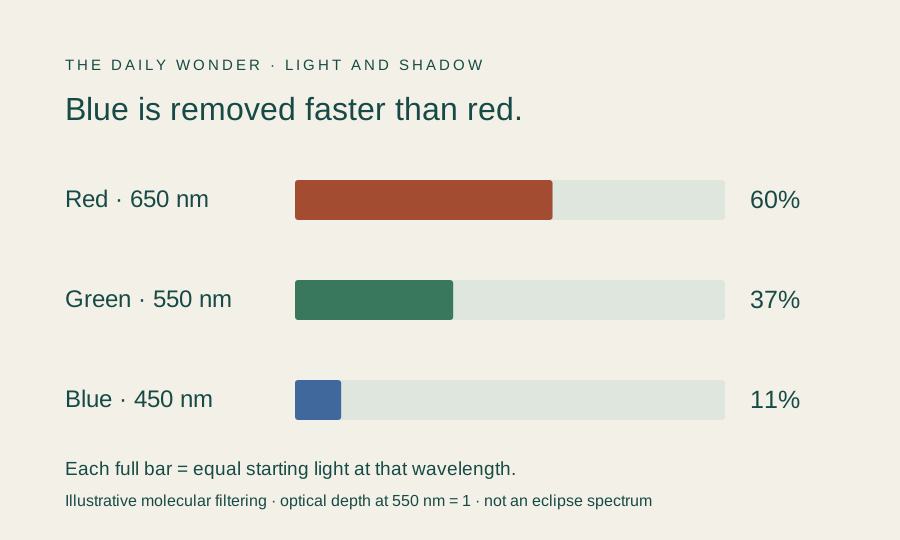
Increase the model's air-path setting. All three bars shrink, but blue shrinks faster. The red bar does not need to grow for the remaining beam to become relatively redder. That is an important distinction between a colour becoming more dominant and an object becoming brighter.
A shadow that helped describe our planet
Long before spacecraft photographed Earth, eclipses offered evidence about its shape. Aristotle noted that Earth's shadow on the Moon had a curved outline across different eclipses. A sphere naturally produces a circular silhouette from every direction.
The value of that observation lay in repetition. A flat disk can also cast a circular shadow when viewed face-on, but its silhouette changes with orientation. A consistently curved terrestrial shadow was therefore evidence for a spherical Earth, not merely an attractive shape in one night's sky. NASA JPL recounts Aristotle's reasoning.
The Moon was serving as a distant screen. What appeared on it could reveal properties of Earth that were difficult to inspect from the ground.
Why no two copper Moons are identical
The light's route passes through a variable atmosphere. Clouds and airborne particles can block or weaken it, and different portions of the atmospheric rim need not transmit equally. The Moon's path through the shadow also affects its appearance. A bright orange eclipse and a very dark eclipse can therefore arise from the same basic mechanism.
Large volcanic eruptions sometimes leave stratospheric aerosol layers that strongly dim subsequent eclipses. Astronomers describe visible eclipse brightness using the Danjon scale, from 0 for an extremely dark Moon to 4 for a bright copper or orange appearance. It is an observational classification, not a direct pollution meter. NASA describes atmospheric effects and the scale.
Historical descriptions can even become scientific evidence. In a 2023 study, Sébastien Guillet and colleagues combined medieval accounts of lunar-eclipse darkness with other climate evidence and aerosol simulations to refine the timing of volcanic eruptions. An old description alone cannot identify a volcano, but it can help constrain when a veil of particles affected the atmosphere. Read the open-access research in Nature.
Watch the light's journey
A lunar eclipse is safe to view with the unaided eye; it does not require solar-eclipse glasses. That advice applies to looking at the Moon, not at the Sun. NASA provides the observing distinction.
For a different viewpoint, NASA's animation shows the June 2011 eclipse from the Moon. It places Earth's glowing atmospheric rim where our familiar full Moon would normally be. This is a scientific visualization, not footage from a person standing there.
The eclipsed Moon is still the same rocky world. What changes is the light reaching it. Its copper face is a visible reminder that even a planetary shadow can carry information about the air around the planet that cast it.
EXPLORE THE IDEA
Why the surviving light becomes redder
At zero optical depth every wavelength keeps 100%. A longer air path weakens all three, but removes a greater fraction of blue.
Illustrative molecular-scattering model of a transmitted beam, not a lunar brightness or colour prediction. Equal starting intensity at each selected wavelength. Air-path setting is optical depth at 550 nm, dimensionless; it is not kilometres. Refraction, clouds, aerosols, ozone and multiple scattering are excluded. No animation is needed to compare the bars.